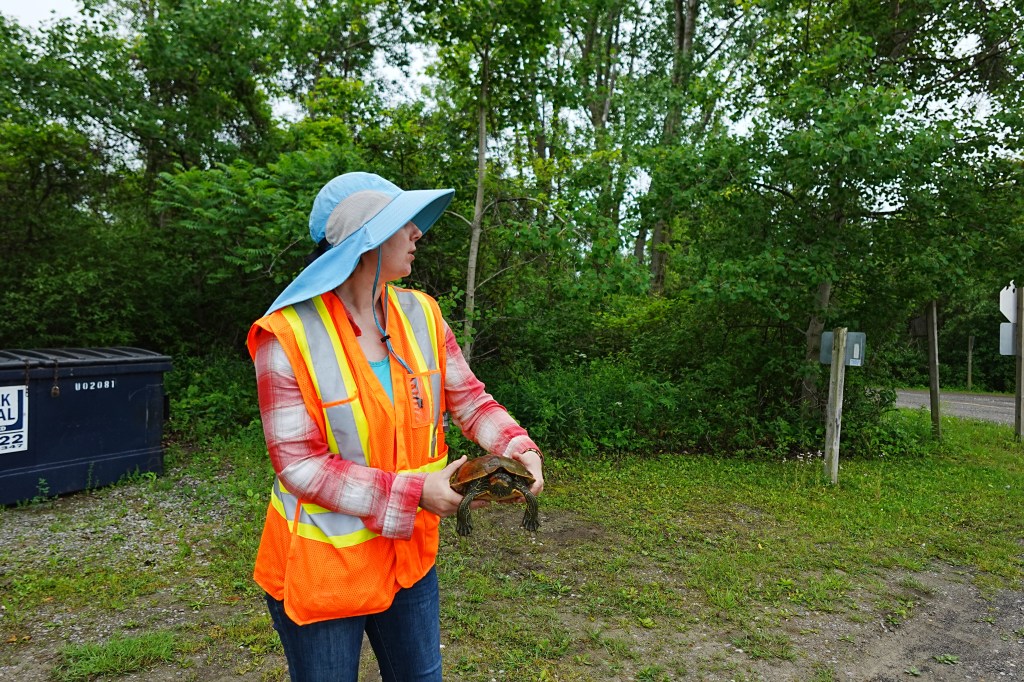
“Individualism is the death of our world, we can’t do things by ourselves, it has to be a community collective, getting together and getting it done.”
Lauren Nightingale
Long Point Biosphere Region, alongside Long Point Eco-Adventures and Eco-Kare International, run a local conservation initiative known as the Long Point Turtle Hatchery. Lauren Nightingale, the Road Ecology Program Coordinator at Long Point Biosphere Region, works alongside staff members and a team of volunteers to protect local turtle populations, and, in turn, the marsh ecosystems they call home.
Throughout the nesting season, the team searches for vulnerable nests and then works to protect turtle eggs laid in precarious locations. When a nest is at risk, volunteers carefully collect the eggs, which are then transported to Long Point Eco-Adventures to be incubated.
The hatchery also serves as an educational opportunity, allowing visitors to learn about the important role turtles play in the local marsh ecosystems.
Local populations of Map, Blanding’s, and Snapping turtles are at risk for a number of reasons. Nightingale describes the top three threats to local turtle populations as “cars or transportation, development, and phragmites.”
For Nightingale, turtles are more than just another species found throughout Long Point; “Turtles are sort of our mascots for protecting the marsh. They are so important to the ecosystem. They are predators, they are prey. They move nutrients and seeds out of wetlands and onto dryland. Turtles are also big garburators, so if something dies in the marsh they are there and they will eat it and clean it up, which reduces disease.”
Their presence is an indicator of the health of the ecosystem, but their survival increasingly depends on the intervention of people like Nightingale and the volunteers who spend their summers searching the roadsides for the nests, monitoring the eggs, and then releasing them back into the ecosystem when they hatch.
For the turtles of Long Point, a journey across the road can be one of the most dangerous parts of their lives. The work of the hatchery is intended to give more of them a chance to make it to the other side.
This year, the organization collected more than a thousand turtles for incubation, the turtles began hatching in early August, and were then released into local marshes. While this may seem like a healthy number of hatchlings, the survival odds for turtles are remarkably low. It can take approximately 1,000-1,500 turtle eggs to produce a single turtle that will live to reproductive age.


Leave a comment